
Trapped in a Bruegel painting
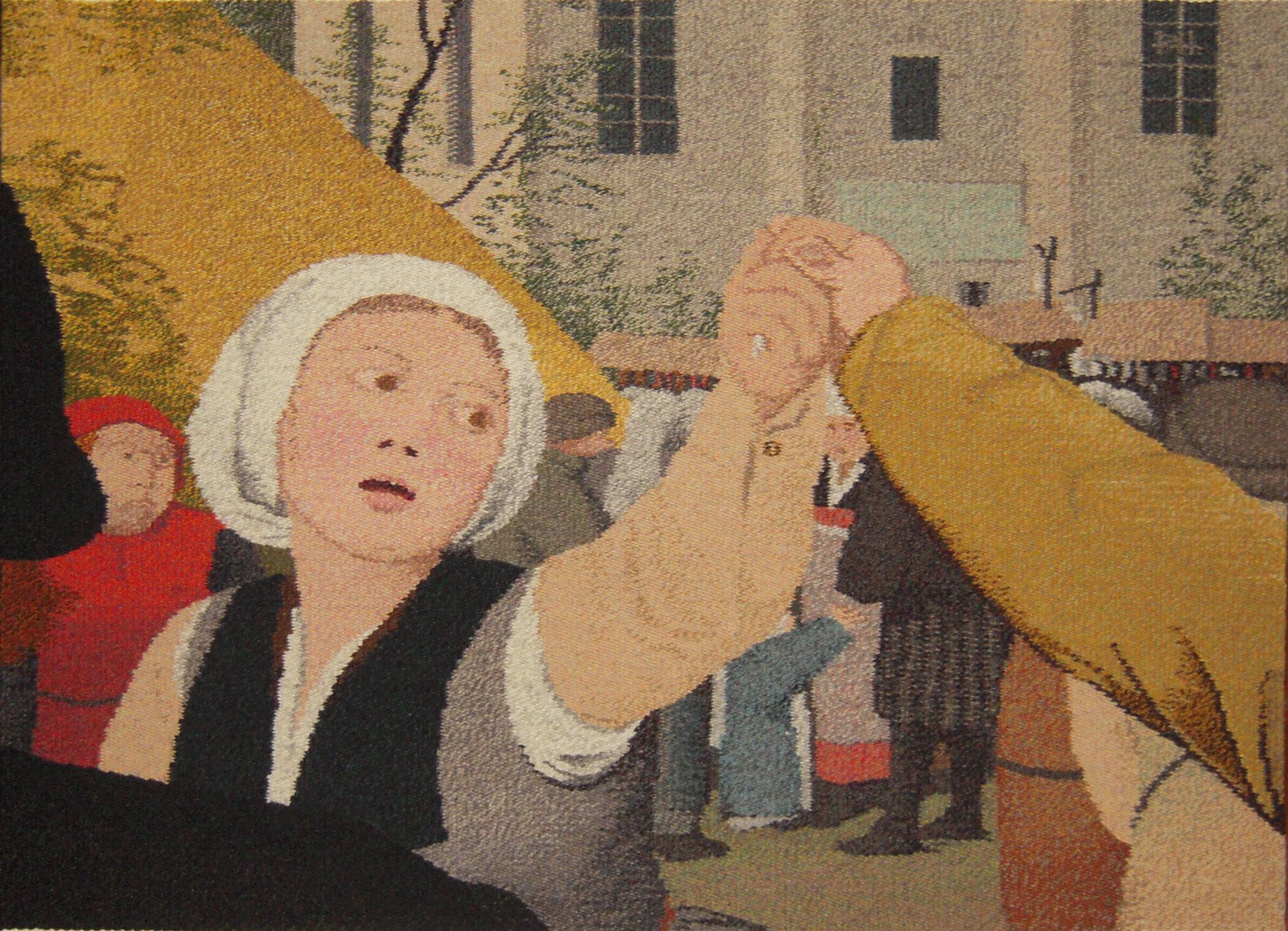
For a year recently I was trying to imagine the life of Bruegel – or look over his shoulder like the companion figure in a supposed self-portrait. Not much is known so the bare outlines seem familiar: in mid-16th-century where is now Belgium, a youth probably noticed for his talent, a successful apprenticeship in an artist’s studio in Antwerp, toured to sights and studios in France and Italy, worked early on designs for engraved prints (you might say calendar art) and later on paintings as he gained recognition, married his apprenticeship-master’s daughter, set up shop in Brussels, died mid-career in his 40’s.
For an artist whose work was collected during his lifetime, his surviving oeuvre is surprisingly small, and shows him turning to several popular genres – landscapes, Classical and Biblical stories, months, caricatures of everyday life. “The Village Kermis” (a fair in support of the local church) also known as “The Peasant Dance” that my tapestry project is taken from, is one of just two or three paintings, from the last years of his life, with eye-level perspective and “monumental Italianate” figures. I picked it for the volumes and gestures of its figures, the magnified three-dimensionality of the space, and the open face of the young woman.
I noticed that of the hundreds of faces that Bruegel has drawn, almost all are turned away from the viewer, engaged by whatever interaction in the painting, portrayed with irrepressible satire. More than that, it’s a black-and-white mix of detailed drawings that suggest real people, and vague sketches just meant to convey a reaction. The young woman in my tapestry is one of only two or three front-facing portraits I’ve found, where you might think the person was looking back, even accidentally, from the painting. Another looks out from “Haymaking”, and in “The Peasant and the Bird-nester”, the look is part of the narrative.
Tapestryweaving was a recognized trade at the time – Bruegel would have been familiar with the opportunity to design for tapestry, and was given a commission for a set of designs late in his life, but there are no remaining tapestries or designs attributed to him. A tapestry designer was expected to prepare actual-size, painted “cartoons”. The setting of that novel “The Lady and the Unicorn” by Tracy Chevalier, about the commissioning of a set of tapestries, is 60 or 70 years earlier, “end of the 15th century”.
I have long felt that Bruegel’s paintings made excellent tapestry cartoons because of their story-telling, and space-filling detail. Compared with a photograph, I get the advantage of the painter having composed the scene of purposeful details, and I get the obligation to him that everything is important. It helps me hugely to be able to identify and visualize every object, to go on to represent it in another version. I was lucky to find close-up photography available at insidebruegel.net.
Bruegel’s early work designing for printmaking was based on his drawing skill, and it literally shows through in his painting, in a style that is problematic for a tapestryweaver, not only positioning the stitches of the artist’s line exactly right, but also weaving up to them on both sides with the background wefts. Arguably, my habitual style of tapestryweaving using a coarse sett (2 or 3 warps per cm.) and wefts of mixed colours is more like the fat brushstrokes of the impressionist or pointillist painters. So I have to decide which outlines need to be there for emphasis, and what can be suggested by other means such as shading the edges, or simply contrast control.
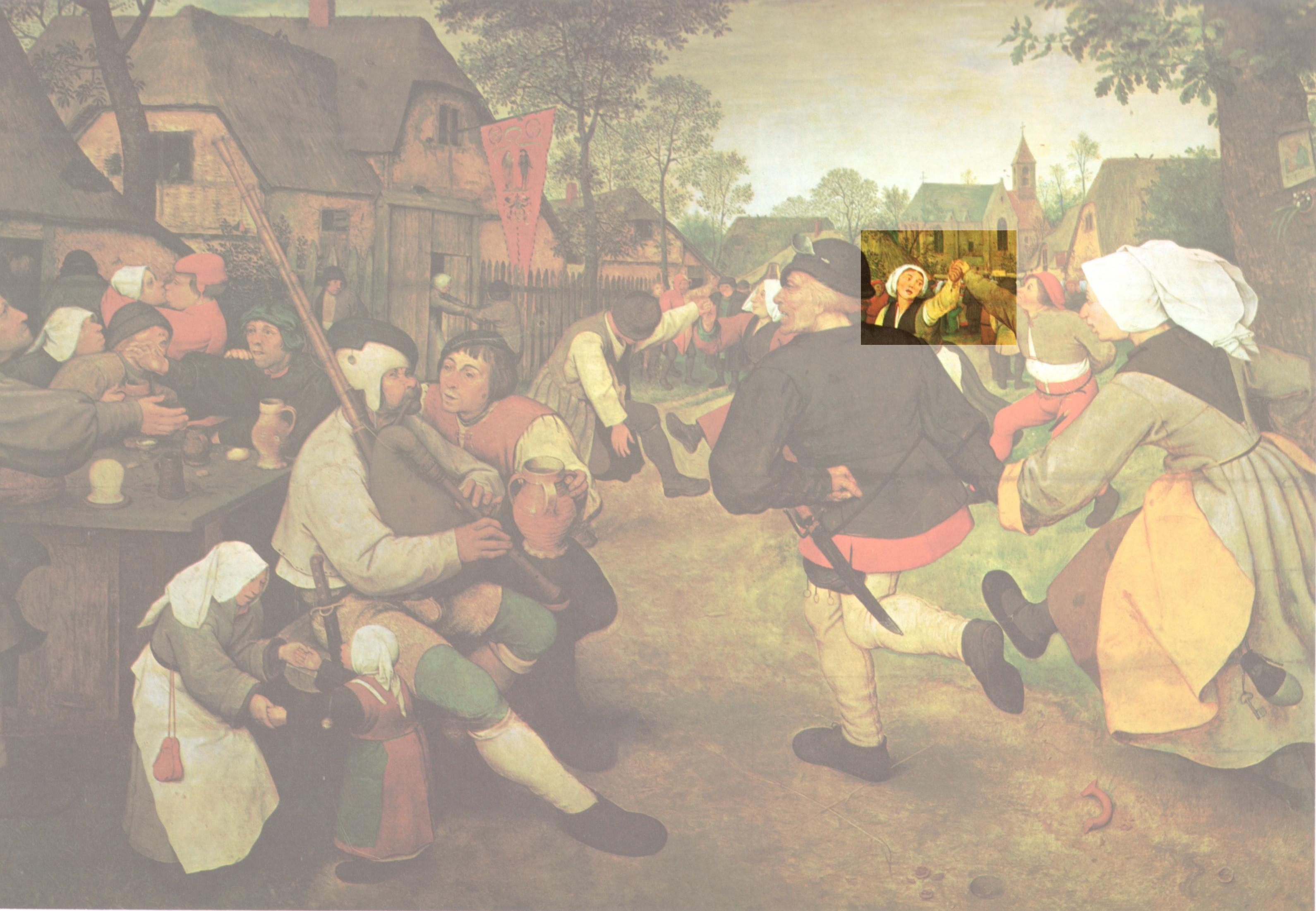
Bruegel is sometimes called a miniaturist. The portion of his painting that I am copying is about the size of a large postcard, the young woman’s face the size of a thumbprint. At the scale I’m weaving (48 inches wide), her face is a larger-than-life-size presence, but other details range down to smaller than I can represent – even something obvious as an eyebrow can go from surprise to skepticism in a couple of stitches.
Ironically, there is a question sitting right in the spotlight: What is the young woman holding in her hand? The hand-clasp with her dancing-partner is one of the focal points of my composition, and there is a bright highlight below her little finger that can’t be overlooked. Is her thumb resting against the top end of the same object? A handkerchief? A rosary? A bobbin? Or is it part of a vine wedged into an angle of the church wall in the background? And why is the skin tone of her hand so much darker than his? Is she a dyer?
Nevermind the anatomical difficulties also present. A friend objected that her curled fingertips should point toward her wrist, and her index finger (if that’s what it is) is probably dislocated. Some other Bruegel people show signs of being patched together from separate life-drawing studies.
As a tapestryweaver I have ample time to wonder, What is that object and its significance? as I am working my way up to it. It’s not only a challenge but also a responsibility not to de-emphasize or misinterpret some detail that might be important. I assumed from first sight that the background figure at the peak of the arch formed by the two upraised arms, is the village priest, wearing a surplice and mitre. In discussion with a friend, she assumed it was a woman wearing an apron and headcloth. The clothing appears to be open at the neck, showing skin-tone in shadow, where I would expect the priest to be wearing a collared shirt. This appears to be one of those cases where to colour it right for one interpretation will be wrong for the other. Days ago, I opted for my best judgement of the paint colour, but, tapestryweaving being what it is, I’ve been engaged in other parts of the advancing edge, so it’s not too late to change my mind…
…For the last couple of weeks I have been struggling to get the best expression of the young woman’s eyes in my tapestry, not unexpectedly, but it’s difficult because the face is tilted, the range of tones used is very limited, and her expression is ambiguous – I think, or I want it to be so. I think I’m getting close. As I un-weave my way back to something I have to fix, I just hope I remember the bits I want to repeat same as before…


 peter harris, tapestryweaver