Weaving from Kashmir shawl talim, four picks or two?

•08/06/2012 • 1 Comment

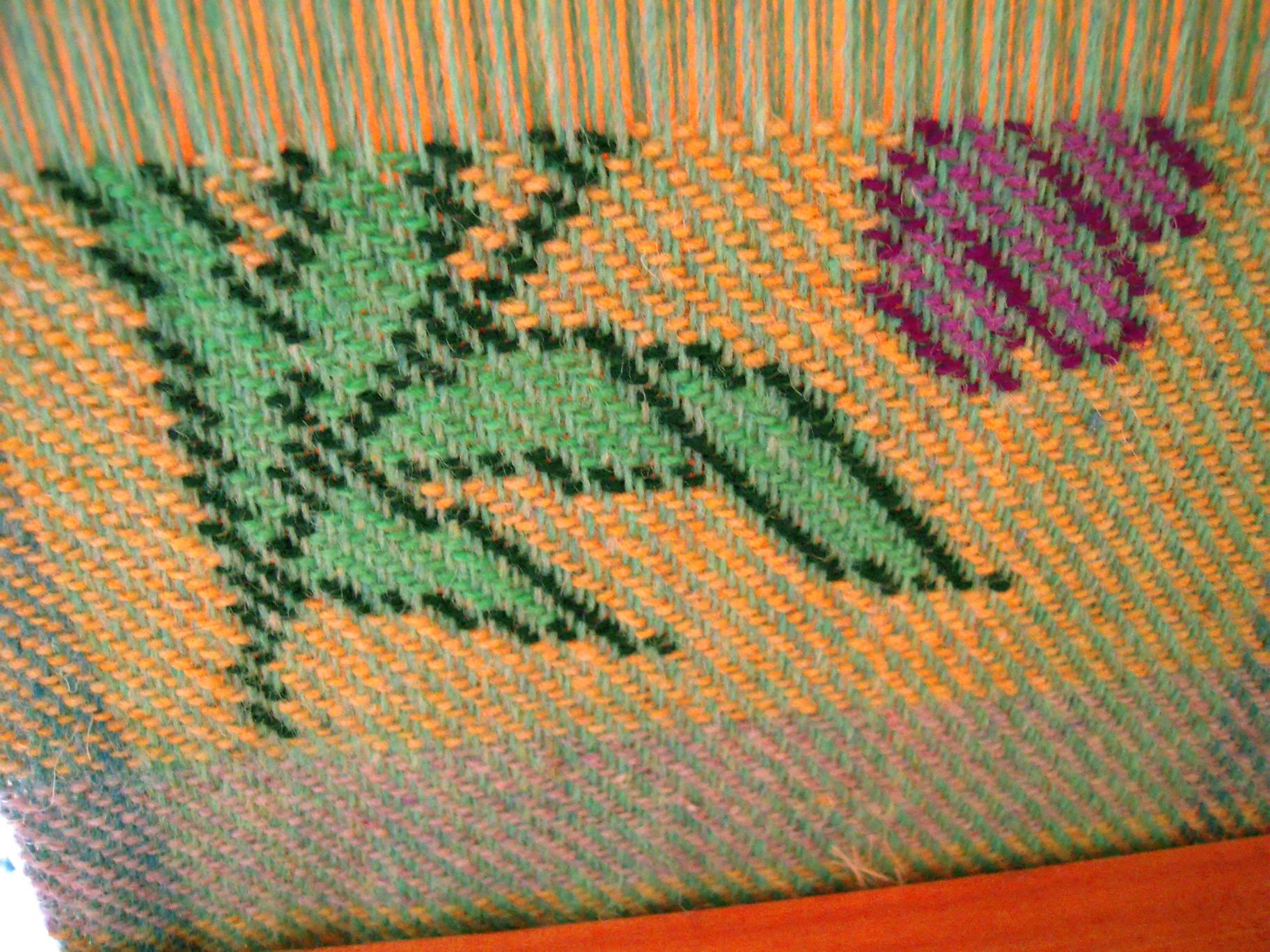
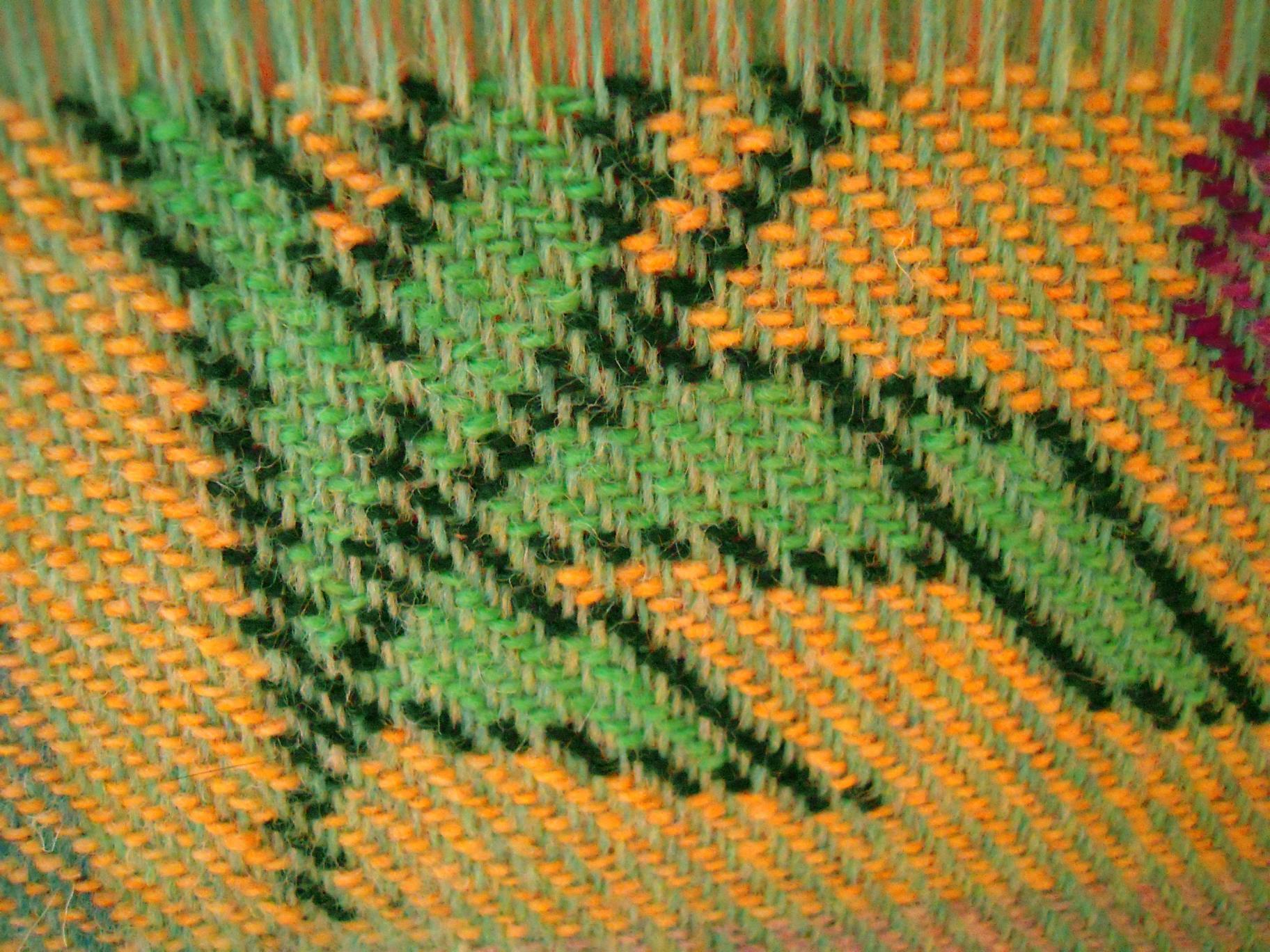
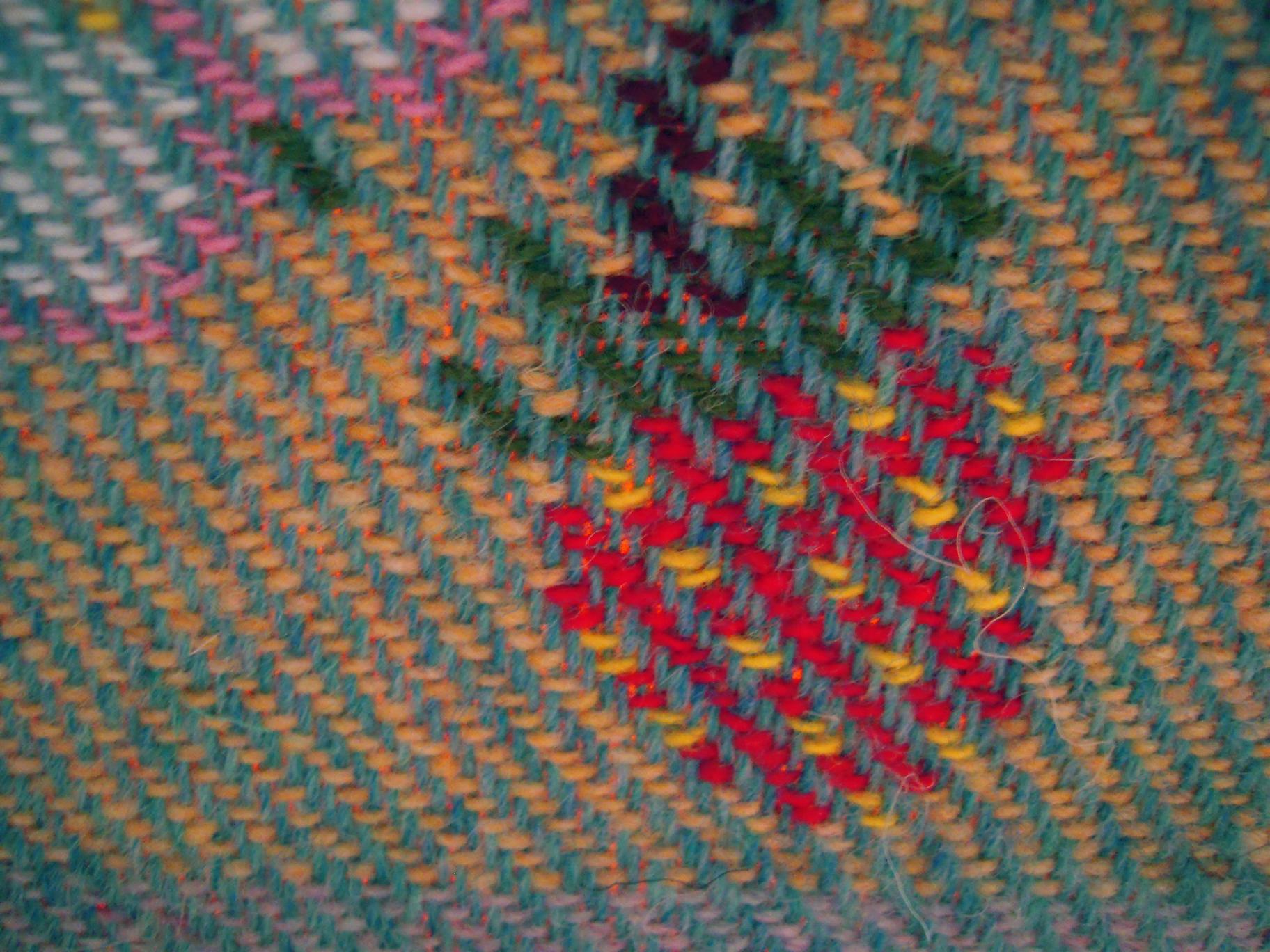
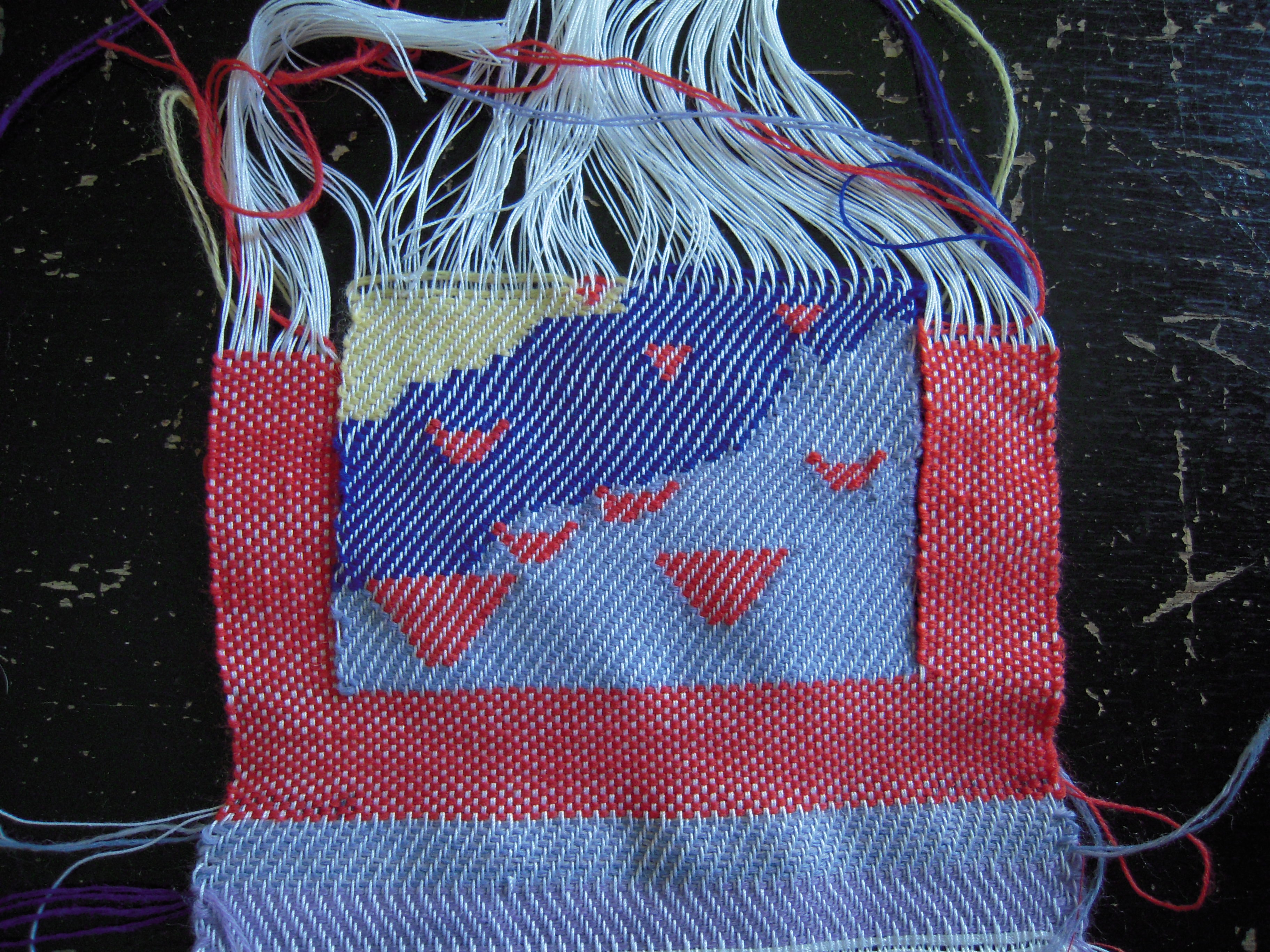
A question that has dogged me from the beginning of my study of shawl “talim” (the instructions in text form that convey design information to the weaver) is how many picks of weaving are made according to each line of the instructions.  On my recent trip to Kashmir, I associated other people’s dissatisfaction over the jagged appearance of woven motifs with the prevailing practice of four picks per talim line, and tried to make the key part of my message to shawlweavers my argument for two picks per talim line.  It is a technical subject, where analysis of the resolution of the design in the weave structure guides workable routines of the weaver’s practice to produce the best results, typical of the historical standard, from which contemporary practice has slipped.

The traditional Kashmir shawl is woven using a combination of twill weave structure, and tapestry-style selection of different-coloured wefts according to the requirements of the design.  The twill structure is one of the simplest, described as a 2/2 straight twill, where each weft thread passes over two warp threads, under two warp threads, and repeat.  In the next pick the warp threads that the weft passes over two and under two, shift one thread to the right.  After four such steps, the weft thread is again passing over and under the same pairs of warp threads as in the first step.  So one “weave unit”, the smallest identical set of threads in the weave structure, involves four warps and four wefts.

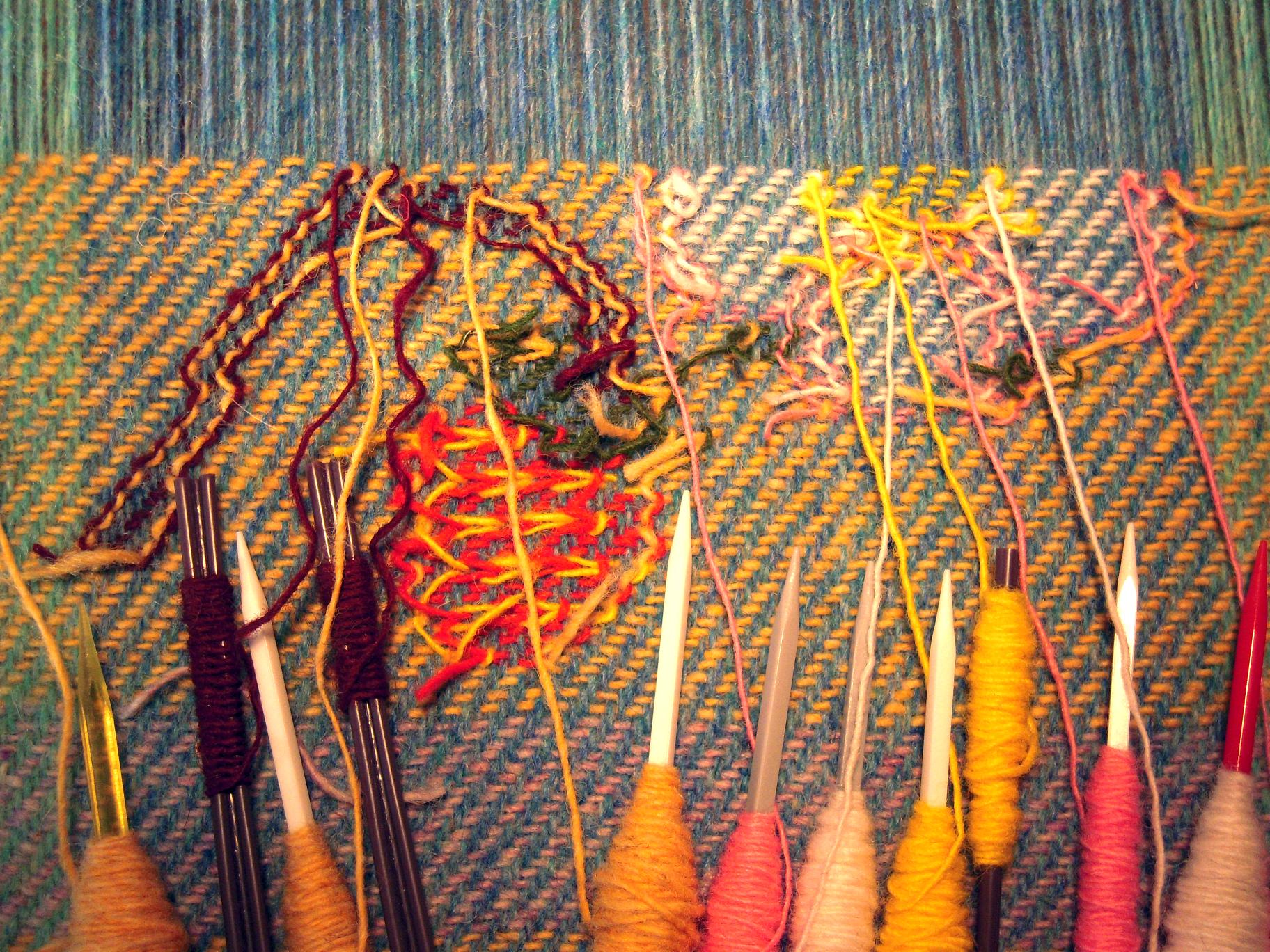
In practice, the harness of the weaver’s loom raises two and lowers two out of each four warp threads – each raised pair called a “nal” – creating the “shed” or space that the weft is passed through.  (The weaving is done with the back side of the fabric uppermost on the loom, so the front is face down.)  Each nal that the weft passes under produces one stitch of weft colour in the design on the front of the fabric.  The number of stitches, or nals – or pixels in other words – in the width of the design will be one quarter the number of warp threads.  It is extremely difficult, but not impossible, to produce any more detail in the width of the design than the number of nals allows.

The warp threads of the fabric will likely all be the same colour – or possibly arranged in stripes – which will contribute somewhat to the background colour of the design.  It is really the placement of the different-coloured wefts that define the design.  In each pick the talim prescribes a series of steps in which a weft of one colour passes under a given number of nals, then is exchanged for another weft colour which passes under the next number of nals, and so on, until the pick is complete from one selvedge to the other.

twill line comparison

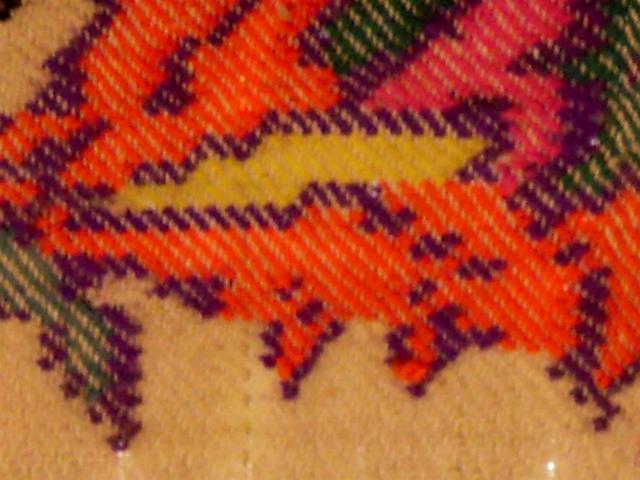
Now the question: for the next pick, is the same – or a new – line of instructions to be followed?  There are three reasonable possibilities.  In the first case, it would be logical to follow the same line of instructions for four picks, the complete weave unit; that would provide the same design resolution lengthwise as widthwise, and the next set of four stitches comprising a pixel would be directly above the previous set.  The design could be mapped on a square grid for shawlweaving just as it is for hand-knotted carpets.  Following this logic in its simplest form, the four stitches would line up in one diagonal row as the nals shift by one warp thread in each of the four picks [on the left in the illustration “twill line comparison”].  These little diagonal rows have the most jagged appearance and disruptive effect on the small details of the design.  Because of this, a refinement has been developed in which one nal is deducted at the beginning of the third pick, so that the third and fourth stitches appear more directly above the first two, instead of continuing in that diagonal row [at the center in “twill line comparison”].  This tactic tends to balance and reduce the effect of the four-step twill diagonal progression on the design, and is the widely-adopted shawlweaver’s practice today.

Jumping to the third possibility, the weaver could have a different set of instructions for every single pick.  I haven’t seen this in written form, but in a large, continuous design the weaver would need a way to keep track of which pick out of the four in each weave unit is being worked on, before resetting the starting point at the beginning of the next weave unit.  Memorization plays a big part in weaving repeated motifs, and I can accept that the weaver may have memorized pick-by-pick adjustments to make perfect all the details of small repeated motifs.

In the second possibility, the weaver would follow a line of talim instructions for two picks of weaving, so there would be two lines of instructions for each weave unit.  After treadling for the first pick, each weft is inserted in sequence from left to right, as the talim text appears to be written.  The next shed is treadled and each weft is inserted from right to left, by reading the same talim line steps in reverse order.  Each weft is returned to approximately its starting point at the previous pick, except for the shift of two warp threads caused by the two treadlings.  Advantages to this are: it confirms that the counting of the instructions was followed correctly; it facilitates the snug double-interlock of weft threads (that doesn’t need to be discussed here); and it provides a familiar starting point for each weft for the next line of instructions, which will probably be mostly similar to the previous line.

My argument that the second case was the basis for shawlweaving practice during its golden era, is threefold: the evidence for it is there to see in antique shawl fabrics; surviving shawl talims mark the alternate lines of talim text to establish their relationship within each weave unit; and it enables superior resolution, grace, and detail in shawl designs.
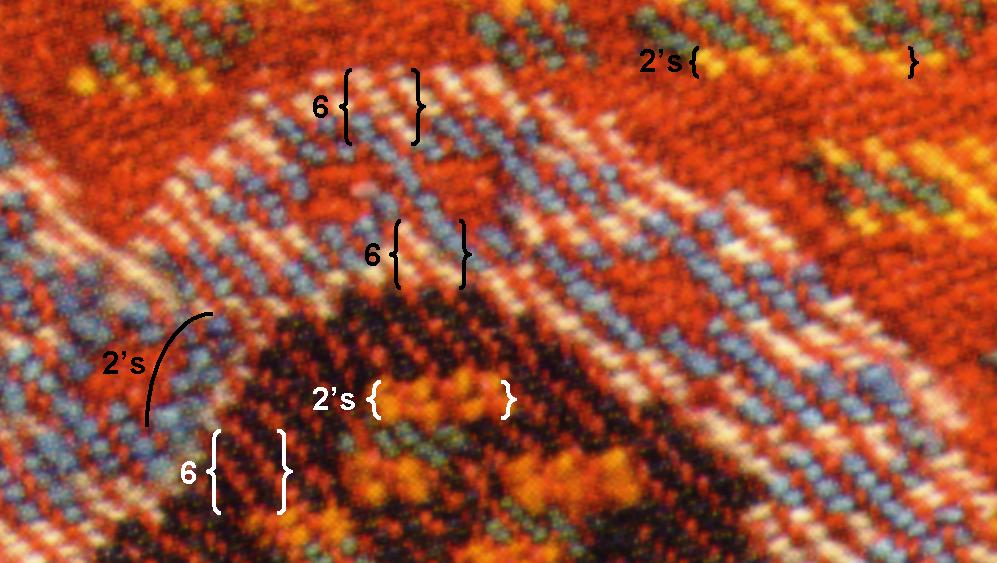
On two illustrations of antique shawl fabrics, both from the late 19th century, I’ve noted some examples of stitches appearing in multiples of 2’s and 6’s, not just 4’s as current practice would dictate.  Though the style of the designs differ, they are both relatively large-scale, beyond the scope of memorization, and so, dependent on recorded instructions.  I have seen one claim reported by E. G. Marin in 1933 that the talim system was invented in the 18th century.  In another shawl fragment dated to the early 18th century at the latest, a mistake in the design between two identical motifs suggests written instructions were being imperfectly followed, and also shows some details in multiples of 2’s.

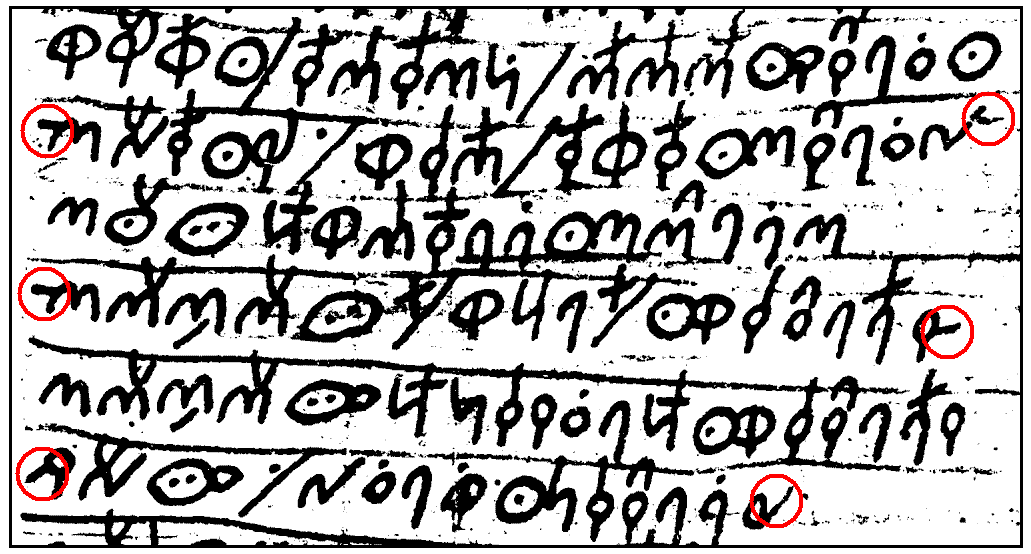
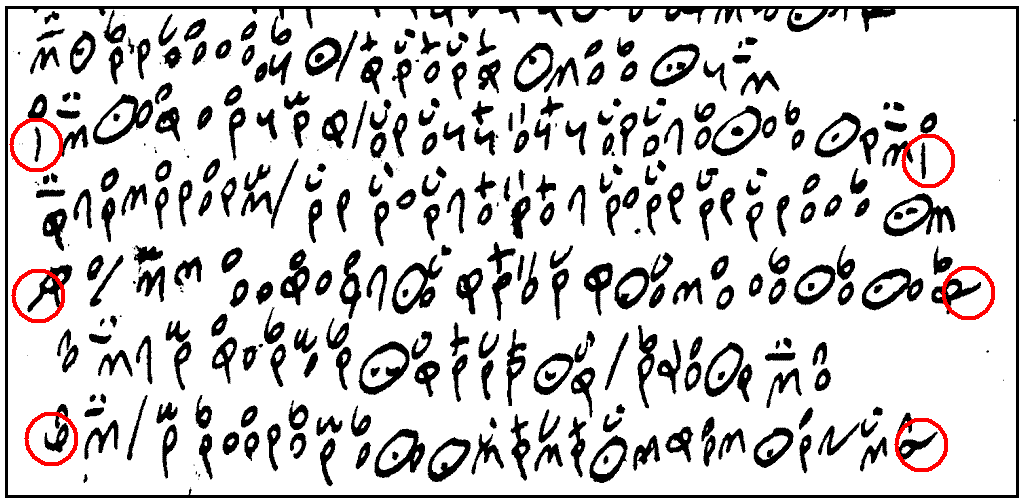
Each line of a page of talim text, whether it covers the full width of a smaller repeated design, or a section of a larger continuous design, spans a consistent number of warp threads – the total number of nals in each line will be the same.  But if the instructions in the following line have shifted by two warp threads, those two threads may appear to be unaccounted-for.  In the case of the current practice where one nal is subtracted at the start of the third pick, that is only necessary at the selvedge because subsequent repeats or continuations follow the correction automatically.  Where the instructions change for each two picks, every alternate line, to account for the orphaned warp threads, will show a “half” nal at the beginning and end of the line of text, which together with one less “complete” nal will add up to the same total number of nals in each line.  This feature can be seen in the illustrations of older shawl talim text – a half nal is written as a straight vertical stroke, or a horizontal tick added to the number symbol it is combined with.  Each half nal in this position will typically be the same colour as the next adjoining half nal, and will be woven as one.
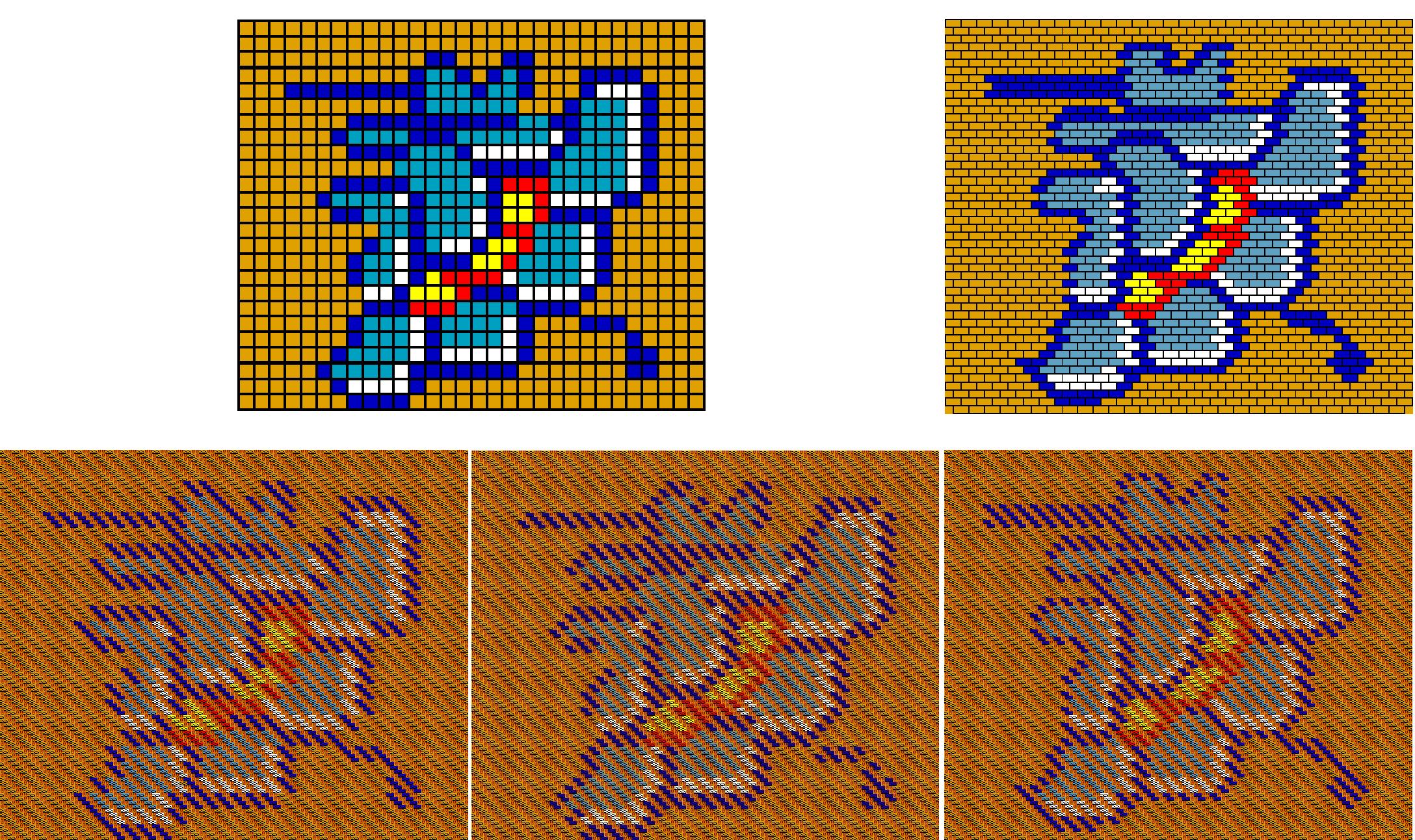
four picks at left and center; two picks at right

This arrangement of rows of nals with half nals at the ends of alternate rows, to represent the off-set of the twill treadlings, can be helpfully visualized as a “brick” grid, where each brick represents one nal and two weft stitches.  The height of two bricks (four wefts) would be the same as the width of a brick (four warps), and the corresponding bricks in the next two rows would be positioned directly above.  So to create designs on a brick grid of these proportions would be very similar to designing on a square grid (where each square represents four wefts and four warps) but it would provide a closer representation of the diagonal twill weave structure, increased resolution, smaller details, more delicate and responsive curved lines, and other subtle optical illusions familiar to tapestryweavers.  To fully explore these possibilities and other refinements such as actually weaving half nals, goes beyond the scope of this article, and requires designing informed by the weaver’s experience of what’s practicable and how it will appear in the finished fabric.  Not all of the legacy of shawlweavers’ skills can be captured in a few lines of instructions.

The advent of computer-assisted design has been a big improvement over designing on grid paper, facilitating corrections and alterations, and generating the line-by-line instructions convenient for weavers.  In Kashmir, professional-quality software is available for the hand-knotted carpet industry that provides talim-style instructions using the “shawl alphabet”, the same shorthand symbols for numbers and colours developed for shawlweavers, but based on the square grid suitable for carpet where the knots line up in rows and columns.  (It was pointed out that in some carpet designs every line of instructions may indeed end in a half unit, but this is only meant to show that, in the case of mirror-repeat designs, the column that the design turns on is not repeated.)  That this software is considered adequate for contemporary shawlweavers, encourages the less satisfactory practice of four picks per talim line.  Fortunately, from early in my studies I had a CAD program called Stitch Painter, that provided the brick grid used to design for a type of bead weaving, but it only produces line-by-line instructions using cumbersome Western letters and numbers.  What’s needed is a program that uses the brick grid and familiar shawl-alphabet characters.  Shawlweavers will recognize that it more accurately reflects the progression of threads on their looms, and appropriate design instructions will prompt them to reach finer results.
From Srinagar to Jammu

•30/05/2012 • Leave a Comment

waterside shop, Srinagar

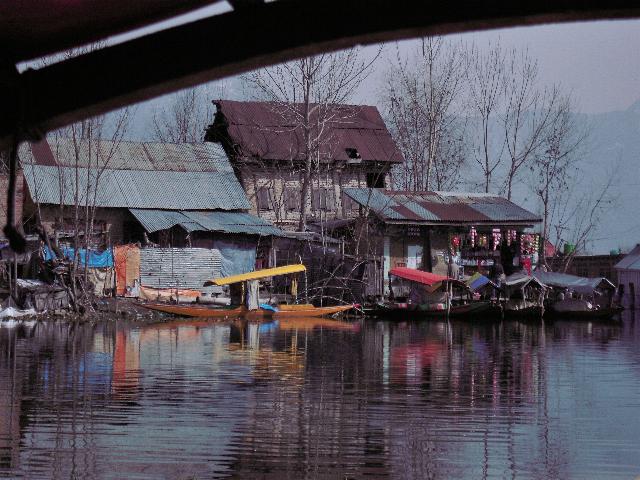
There was a guy I kept bumping into on the Boulevard who managed a houseboat – toward the end of my stay I was trying to arrange my road trip from Srinagar to Jammu to connect with my train reservation back to Delhi.  I managed to get mixed up with this guy, and a “brother” of my friend the shikara boatman, who was promoting the car trip I needed, showed me a fancy, locked SUV in a parking lot and said this is your seat, just pay me a deposit, I’ll pick you up Sunday morning.  Meanwhile from the sidelines my guy was giving me the wink to say, don’t do it.  I couldn’t extricate myself without giving up a couple hundred rupees deposit and we all parted.  Twenty minutes later I’m walking along and there’s my man, sitting there in my path grinning, like my guardian angel.  I sat down, we agreed the other fellow would never show up, and it would be so late I’d miss my train.  So we proceeded to make our OWN arrangement, to meet at 6:30 instead of 8:30 Sunday morning, and I ended up, over tea in the kitchen behind his weatherbeaten houseboat, giving HIM a deposit – I walked back to my hotel thinking, what have I learned, really?  But Sunday morning there he was coming along the path behind me.  Out on the street he hailed a shared-taxi-style SUV that came along, he spoke to the driver, but it was to my man that I gave the balance of my fare.  Added to the usual mix of spectacular views from the cliff-edge roadway, the local short-haul passengers we picked up along the way who had had time to eat breakfast and promptly puked it up on the floor, the lengthy jams where the waves of northbound and southbound traffic meet at midday, the busy roadside eatery with grubby atmosphere and surprisingly good food, was my wondering when the driver, a big aggressive type, would say, I don’t know who your friend was, you owe me Rs. 1000 for the fare.  In the end, we got to Jammu in plenty of time, everyone unloaded, I gave the surprised and cheered driver a well-earned Rs. 100 tip, and I was on my way.  Next time in Srinagar, I know whose houseboat to stay at.

From my journal:
The road trip was spectacular from a distance, more depressing up close.  The predawn twilight was bleak and grey at this season.  The most noticeable activity was the military foot patrols lining the road every few kilometres, usually with a sniffer dog.  For some distance we followed the left bank of the Jhelum – though I didn’t notice, we were probably moving upstream.  The road was lined narrowly with strip development – unfinished houses and businesses thrown up in response to the increased traffic of recent years.  As I recall in 1985 the most noticeable traffic obstacle was flocks of goats – hard to imagine that now.

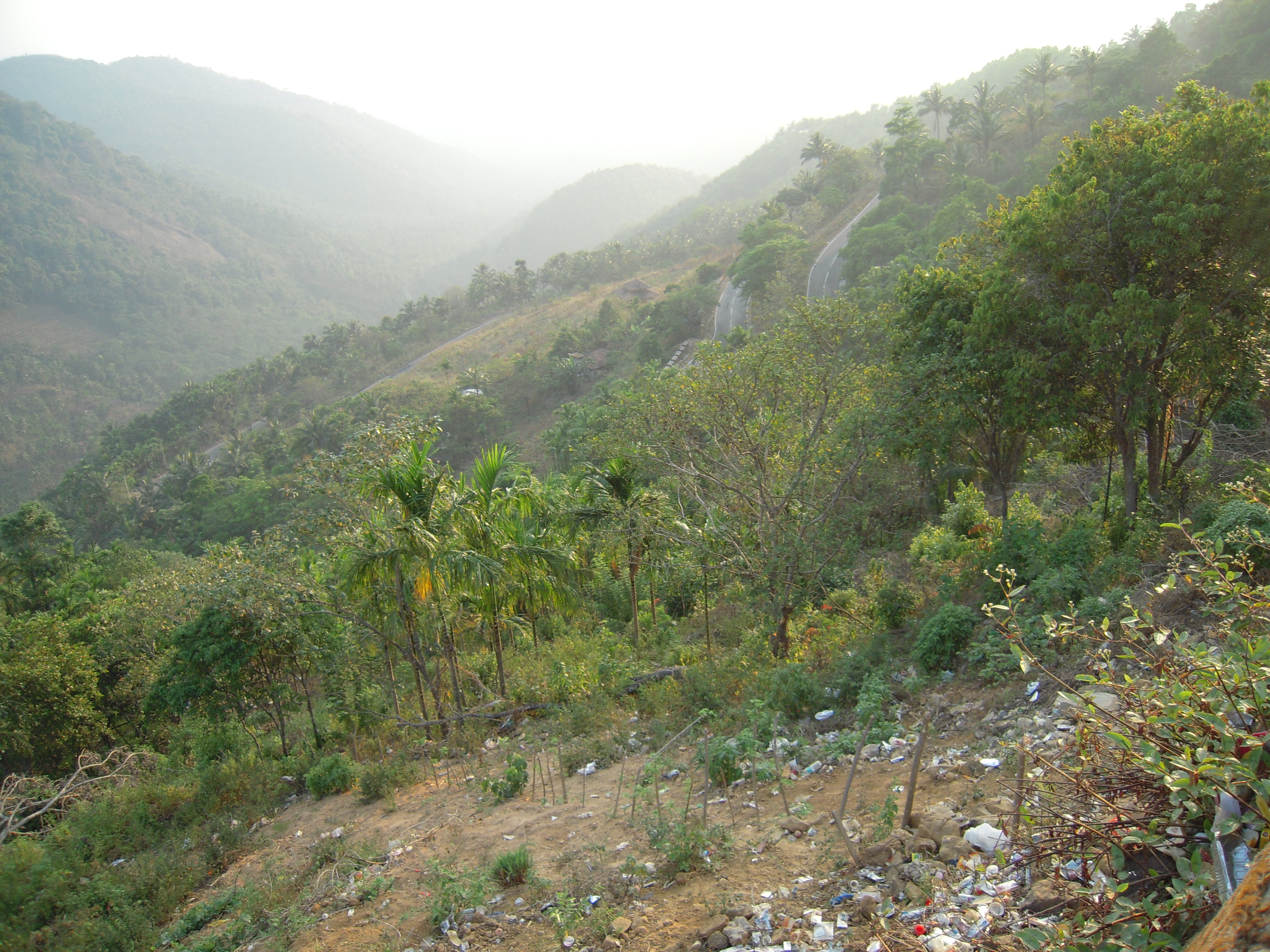
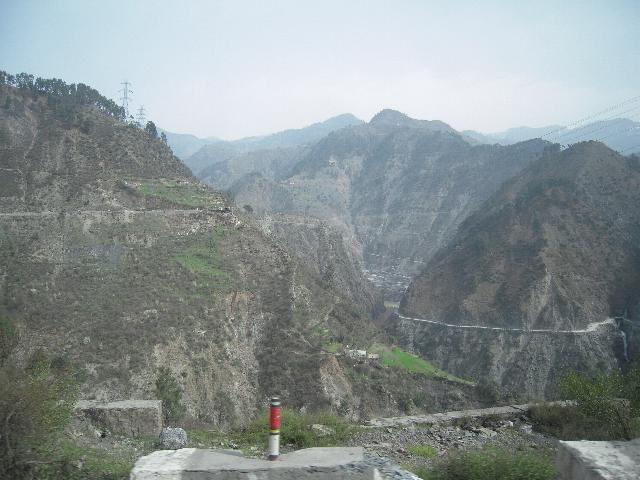
The mountains closed in as we climbed toward the tunnel at Banihal.  Eventually there were remnants of accumulated snow on the uphill side of the road, until at the tunnel we seemed to disappear into a deeply-snowcovered slope.  On the Jammu side, the snow quickly receded and the landscape seemed warmer but much more dry.  The ride was still thrilling as we snaked our way along the shoulders of deep, narrow gorges of the Chenab River – confusingly we were moving upriver for a stretch.  We stopped for lunch at a busy, grubby but respectable dhaba perched on the edge of the precipice.  Out the back door it was a hard left turn, after pausing to admire the view, to the toilet cubicle tacked on the back of the building.

Chenab River gorge

Irrespective of distance, we reached the half-way point when we negotiated our way through the flush of early morning northbound traffic – innumerable lorries and a Sunday contribution of vacationing family carloads.  Toward the end of our drive, the northbound traffic dwindled as there would be no place to reach before dark.

Our driver was experienced, knew every inch of the route, moderately daring and aggressive, and critical of other drivers’ idiocies.  I could see that he was alert to oncoming traffic further ahead, so his passes on blind curves were carefully calculated – something I could detachedly understand, but never imitate.  The conventions of Indian driving, applied to mountain roads, are unnerving.  Meeting an oncoming vehicle, you steer for his nearside fender and hope there’s enough of a gap or margin of pavement, when you round it.  If not, you brake, and let what’s in front of you sort itself out.  Trucks, especially tanker trucks, are the bullies of the road – nose to nose, everything smaller must yield or stop.  Trucks will pull over for a rest stop, nevermind that it creates a one-lane bottleneck and tedious backup in both directions.  When traffic is blocked, the lane beside you will fill up with opportunists trying to slip by the nose-to-tail traffic jam, so it takes forever for alternate parts of the line-up to get clear.

Shawlweaving in Kashmir

•15/05/2012 • 1 Comment

In Kashmir in mid-April, I can imagine the apple blossoms in orchards and on hopeful new plantings in people’s back gardens.  A month ago, a country-person estimated it was three weeks to blossom time, in spite of their “coldest winter in 16 years”, and I answered that ours in central Ontario would be a couple of weeks later, nevermind the mild winter here.  The climate, the range of the seasons, the trees and flowers, seem all very similar, especially after the flat roofs and sub-tropical dryness of India.

kani shawl weaving demonstration at School of Designs, Srinagar, March 2012

I was in Srinagar for two weeks, for the first time since 1985, after soliciting an invitation from the University of Kashmir, to offer a workshop on computer-assisted-design applications for the traditional tapestrywoven Kashmir shawl.  It’s a subject I have studied independently for more than 20 years, based on published photos of spectacular antique fabrics, and a tapestryweaver’s understanding of what’s required.  Shawlweaving has been observed with fascination and documented in the past and present, but usually with only the vaguest notion of what goes on in the weaving.  Myself, I was riveted by the shawlweaver’s daily challenge of weaving from a text of line-by-line instructions to reproduce dependably a subtle and detailed design with seemingly no stylistic restrictions.  The advent of the computer has contributed a lot, not only to our contemporary understanding of digital images, but to the reconstruction of old designs and preparation of new ones in Kashmir’s continuing knotted-carpet and shawlweaving industries.

contemporary shawlweaving at 4 treadlings per line of instructions

I am conscious of the need to be modest about what I could possibly teach to traditional weavers, but I had a particular point to try to get across, based on my observations of historical material, that isn’t being practised today: designs should be prepared so that there is a change of the weaver’s instructions for every two treadlings, not every four treadlings as is currently done.  The amount of weaving is the same, the instructions change twice as often, and the resulting woven imagery is more detailed and graceful, as it was in the past.  The technical nature of my proposal and its implications for the weaver’s work routine, had major influence on the planning of the workshop and the variety of meetings I had with designers and weavers.
My invitation was from the Information Technology and Support Systems Directorate, a project-oriented department responsible for integrating new computer resources into the University’s activities.  I had gotten my encouragement to inquire from an earlier project titled “Graphic Designing for Kashmiri Handicrafts”, and framed my proposal as being intended for designers and students, to take place in a computer-lab setting I expected the University would have.  There was a Fine Arts Department at an off-campus location, but no applied-arts program related to textile design.  I was reluctant to approach individual businesses, for fear of getting caught up in rivalries among competitors that I didn’t know well enough to choose between.
I arrived in Kashmir a week before the workshop was to start, just as my hosts were considering the question of who we could expect to attend.  The student world of the University, here as anywhere, is somewhat isolated from the larger community.  Because Kashmir is a cause celebre in India, and formerly gained much of its prosperity from its handicraft industries and tourism, there are numerous government departments and institutions at the central and state levels, whose mandate is to support these sectors.  The University chose to work through these institutional contacts – the Craft Development Institute, the Indian Institute of Carpet Technology, the School of Designs – and I visited several of their directors myself to describe my project and the kind of participants I hoped to attract.  In our conversations and subsequent defaults, I accumulated a picture of bureaucratic priorities, limited mandates and resources, and discouragement at their inability to remodel their constituencies in new and modern ways or even to really engage with them productively.
At the introductory, lecture-based session of the workshop, we started with about 30 individuals, some I recognized or assume had been attracted by word-of-mouth, then the doors opened and another 50 young students trooped in under escort, from the Gov’t Polytechnic for Women, who had been assigned to attend, papering the house and requiring redoubled supplies of chicken patties for the refreshments following.
In the subsequent sessions in the computer lab, attendance was divided between the Polytechnic students who sat dutifully at the computer workstations, and visits from designers wanting to engage me in their own conversations.  Naively thinking that I could get around to everyone in due time, I didn’t manage the classroom situation very well.  The visitors came and went; the students experimented using the Stitch Painter program as intended, but either recoiled shyly at my approach or sailed out purposefully when it was time for a break.  I was grateful to their teacher for convening group discussions a couple of times, but by the last day of the workshop the commitment from the Polytechnic had already ended, and I was left talking to one or two stragglers as the clock ran out.  I think my talk during the introductory session went well, but the University’s assessment of the workshop itself ought to be so disappointed I should just be glad they were too polite to tell me.
As a framework for my two weeks in Kashmir, the program at the University did provide me with wide-ranging introductions to the stakeholders in the shawlweaving industry.  Shawl designers and weavers are often characterized as two separate groups, the designers computer-literate, younger, isolated and frustrated by lack of employment, and the weavers poorly-paid and exploited, lacking the education and opportunities to improve their situations.  The history of Kashmir’s exploitation extends back long before it became symbolic of the enmity between India and Pakistan, before partition, before it became a favourite summer resort of the British colonizers, to the 16th century when it was annexed by the Mughals, then later usurped by Afghans and Sikhs, largely because of the shawlweaving production they coveted, fostered, controlled, and taxed.  European observers reported, with vicarious indignation, the conditions of captive servitude and meagre rice rations earned by the weavers.  Shawl designers were a class apart from the weavers, fewer in number and priviledged by their talent, like the painters who worked in court ateliers.  The process itself of preparing and transmitting the designs, left weavers passively following instructions and interchangeable on the order of their employers.  But even today people point to certain neighbourhoods of Srinagar having concentrations of weavers with shawl looms in their homes.  This relic of a former economy sounds like a wonderland to an artist-weaver from the West, where handweaving as an economic activity is already extinct.  The same economic imperative prompts the fashionable cynicism alike of the nostalgic and of the progressive, that tapestry shawl weaving is bound to dwindle and give way to more profitable, modern livelihoods.  I’m not so sure.
Call it the wishful thinking of an older person still in the grip of his favourite anachronisms and lost causes, but I’m more hopeful that shawlweaving will survive, and be recognized for its importance to the history of Kashmir.  The craft process from artist’s drawing to fine tapestrywoven fabric is technologically brilliant, showing a deep understanding of the digital nature of woven imagery.  It was advanced for its time, developed into full flower supporting tens of thousands of workers, and still has its advocates today.  Every Kashmiri I meet connected with the shawl industry now is young, enthusiastic, and dedicated, some of them engaged in reviving the family businesses last run by their grandfathers.  And already the connection between shawl designs and computer imaging is obvious enough to be employed by some weavers.
Because of the upsurge of militancy in the last twenty years, there may have been a lost generation of casualties and emigrants, and one might well fear an irrevocable break with the past.  But perhaps the stone-throwing has subsided in favour of a more habitable determination to reassert Kashmir’s cultural distinction and heritage.  When I first started to mention my interest in shawlweaving and the pieces of talim I had collected in the 1990’s, I was surprised that every Kashmiri I met in the diaspora could recognize and read the talim, probably from time spent in childhood apprenticeship to carpet weaving, which perpetuated the technology of the talim text when shawls went out of fashion in the 19th century.  While the talim is part of their common heritage, they are frankly incredulous that anyone outside the tradition, such as I, can read it.  There is a very strong sense of pride, proprietorship, and exclusivity that I think will motivate the survival of shawlweaving, a harmless, arduous, but closely self-identified, dedicated, and ultimately rewarding activity, just as much as Kashmiri self-determination has prompted more dangerous and costly gestures of resistance.
I have long felt there is a social dimension of my own quiet tapestryweaving activity, a nonconformist resistance to the haste and opportunism of the present era.  I would love it if a variety of the work that has become my vocation, continues to signify and reward the pride of its people, and if I, even as an outsider, could contribute to that by my study of what made the best surviving examples of shawlweaving’s golden age.  That pride is probably why it seems so difficult, perhaps impossible, for me to get a hearing, with my unconventional loom, coarse woollen threads, unfamiliar concepts, and critique of current practice – argue as I may that the differences are superficial.  It’s not about modernization or productivity, but all about restoring and upholding the tradition.

Complaints

•25/02/2012 • 1 Comment

Two topics I want to address are litter and dogs:
The Indian instinct is to litter, to immediately drop, toss, jettison, spit, or relieve themselves where they stand, sit, or see an opening.  Get rid of the useless and the unclean.  The view from a train passing by people’s backyards is illustrative: where there is a wall to pitch stuff over, there is inevitably a built-up scree of multicoloured packaging.  The catering on the railway system is itself a major offender: the cleaner who sweeps the aisle pushes all the empty plastic water bottles and other rubbish into the vestibule between carriages and straight out the door of the moving train.  I’ve witnessed the steward of our carriage, a smart and in some ways conscientious worker, casually empty a food tray of its bits of foil and paper, over the side.
By the end of the day, the way is strewn confetti-like with empty packets.  Plastic bags drift among the waterlilies on ponds like jellyfish.  There is nothing to prevent a midden of bottlecaps to build up below the terrace of a restaurant whose raison d’etre is a scenic view, as I recall from an earlier visit to Udaipur – no inhibition, no mental connection.  You would think in a country with as long a history and rich associations of sacred lore with the landscape, there would be a sense of responsibility.  There are whole classes of people, sweepers and garbage-pickers, whose job it is to sweep up and carry stuff away, from city streets and designated areas – the sobering implication is that the carpet of litter you’re looking at is just today’s contribution.
It was all very well when the debris was organic, biodegradable – food service packaging of stitched-together leaves, or even paper.  In the bad old days, railway meals came uncovered on reuseable stainless-steel trays.  But now that plastic carrier bags are reflexively given out with every purchase, and modern products rely on elaborate packaging to validate their status and appeal, what could formerly be counted upon to decay away, now drifts and washes up everywhere accumulating.
Medical advice is that rabies is endemic among dogs in India, and from my Canadian experience I dread encounters with unsocialized, irritated, aggressive dogs, but there haven’t been any.  There are more street dogs than one thinks a poor country would support, but they are probably a tacit part of the predilection to littering and the recycling of garbage, picking over food scraps deliberately left at the roadside and market refuse, like the cattle that are noticeably more active foraging at the end of the market day.
It’s not an easy life, but few dogs look underfed, however worn and scruffy in a climate never cold enough to knock back fleas and other parasites.  Many dogs have a lame foot, the price of learning to negotiate traffic.  But they all nonchalantly curl up in any sunny spot, including the curb lane of city streets, and traffic goes around them.  Among all kinds of vehicles, barrows, pedestrians, and itinerant livestock, moving or paused, like small children they are looked-out-for.  I haven’t seen anyone petting or showing affection, nor abuse.  Very few show any sign of an individual relationship at the end of a leash.  Somewhat more of them sport a cardigan or blanket in this winter season.  They don’t solicit friendly attention, expect to be petted.  I have hardly ever seen a tail wag.  It seems a pathetic, withdrawn, parallel world.  Among themselves, they have a careful, local, structured society – trespass is dealt with vocally, sometimes stridently.  In the night there can be terrible rows and grievous yelping, but from anything I’ve actually seen, it seems mainly theatrical.  In the end I’ve grown not to fear them but to pity their sad, separate existence underfoot, the most companionable domestic animal left to its own devices.

Riding Indian Railways

•04/02/2012 • 2 Comments

For someone from North America, where passenger rail travel has dwindled from the days of its historical importance and cultural assumption, the Indian railway system is a revelation, an undiminished monument to India’s early modern development under the British, and the essential service for moving people around the country.  Without it, the demands on India’s catch-up road network and chaotic traffic would be unsupportable, and domestic flying would never be more than for the few who could afford it.  Visitors owe it to themselves to enter the world of Indian rail travel, experience the services and circumstances it provides, and join, at times, the throng of humanity more vivid and meaningful than any oceanic experience dreamt-of by Herman Hesse or other mystics.  But let me descend to the particular.
My first experiences were when third class was called Third Class, the seats and berths were bare boards, and queueing for reservations at the station took forever.  That it yielded up one’s name, albeit cloaked in haphazard spelling, on the reservation chart pasted to the side of the carriage, seemed miraculous.  More recently the reservation system has been completely computerized, and is even bookable on-line from Indian Railways and several more user-friendly travel agencies.  One disadvantage of this increased accessibility is that quotas are booked up much longer in advance, not just several days as formerly, but probably at least a week or two.  This must lead to a lot of changed plans, in spite of the fares paid, and there is an elaborate system of R.A.C. (reservation against cancellation) tickets which entitle you to board the train and sit in expectation of being found a berth, followed by the faint-hope Waiting List.
My first rail journey was booked on-line before I arrived on this visit.  Compared with earlier experiences, it seemed a little fraudulent for me to be sitting leisurely at home, imagining into existence a trip from Delhi to Kolkata on a certain date, half a world away, and willing a place to be saved for me.  Should I be more surprised for it to be there waiting for me, or not?
My journey to Kolkata was in 3-tier AC class on a Rajdhani train, 1450 kilometers in about 18 hours.  3A was a recognizable 3-tier sleeper carriage: open-sided compartments curtained at night, with larger fixed windows instead of the barred and sliding glass and shutter sashes of second class, as well as fresher maintenance and paintwork.  Blankets, pillows and packaged laundered sheets were provided.  More than that, I wasn’t prepared for the steady stream of catering delivered to our seats, branded without irony “Meals on Wheels”.  First, bottled water was handed out, then a tea tray (a thermos of hot water with fixings and biscuits), then a three-course supper (veg, non-veg, or continental) that began with a cup of soup and bread sticks, then a tray of rice, chapatis and two curries, and ended with a cup of icecream.  The next morning, another tea tray, breakfast (veg or non-veg) with more tea, and then because our train was running late into the lunch hour, another vegetarian meal.  It all added up to a busy time for catering staff (not unlike airline cabin crews) who in the end solicited tips, a mountain of throw-away packaging, and no business left for the usual itinerant tea and snack sellers to ply the aisles.
My compartment on this trip,was as usual packed solid by my travelling companions’ baggage, including a heavy tin chest that converted our foot space to table-top, where they played endless lightning rounds of a card game like bridge, no bidding, just piling up tricks.  All five were a group of middleclass men on a work assignment, and the chest contained equipment too valuable to be entrusted to the luggage van.  One possible reason to travel 2-tier or higher: fewer passengers might mean less of a logjam of baggage wedged in.
My next two journeys were from Kolkata to Varanasi, and Varanasi to Lucknow, parts of the distance I covered in the first trip that barely justify an overnight schedule, but it saves the cost of a night’s lodging, and lands me conveniently early to find a hotel room at the next stop.  The fare for an overnight journey is typically less than half the cost of an equivalent hotel room – being moved along your itinerary is a bonus.
Both of these journeys were in Sleeper class, second class reserved.  Here the carriages are more grimy, the toilets rudimentary, the berths are padded, but there was no bedding or catering provided.  My fellow passengers were different, too.  From Kolkata I was bunked in with a family consisting, as described by a youth who was there to see them off at Kolkata, of his grandmother, three aunts and an uncle, who were returning from a pilgrimage to Puri.  No English spoken, and the uncle wasn’t very sociable and soon retired to the upper berth opposite mine.  The aunts were more tolerant of the foreign male in their midst, and there were some slight, amused interactions over how to put up a suction-cup wall hook, and the appearance of a mouse among the baggage on the floor.  But the uncle’s role was to shield the ladies from outsiders, and overnight he insisted (I think) on leaving the overhead fluorescent on as a night light, even though toward morning it began to flicker annoyingly right above our noses.
The second trip, onward to Lucknow, was shorter and more matter-of-fact, leaving Varanasi close to midnight and arriving at 7:00 a.m.  My companions were an assortment of lower middleclass men, eager to bunk down and catch some sleep before morning.  I was in a lower berth, with my head on my satchel and my shoulderbag in my grip against the partition, wearing my winter coat and toque.  Gradually I became aware of extra passengers sitting perched on the edge of my berth, first one, but by morning three.  I hadn’t been expecting to sleep for security reasons, but before I knew it the sky had lightened, passengers were collecting themselves, and tea-sellers were circulating vociferously.  Chai, ah chai!

Varanasi ghats

•29/01/2012 • 1 Comment

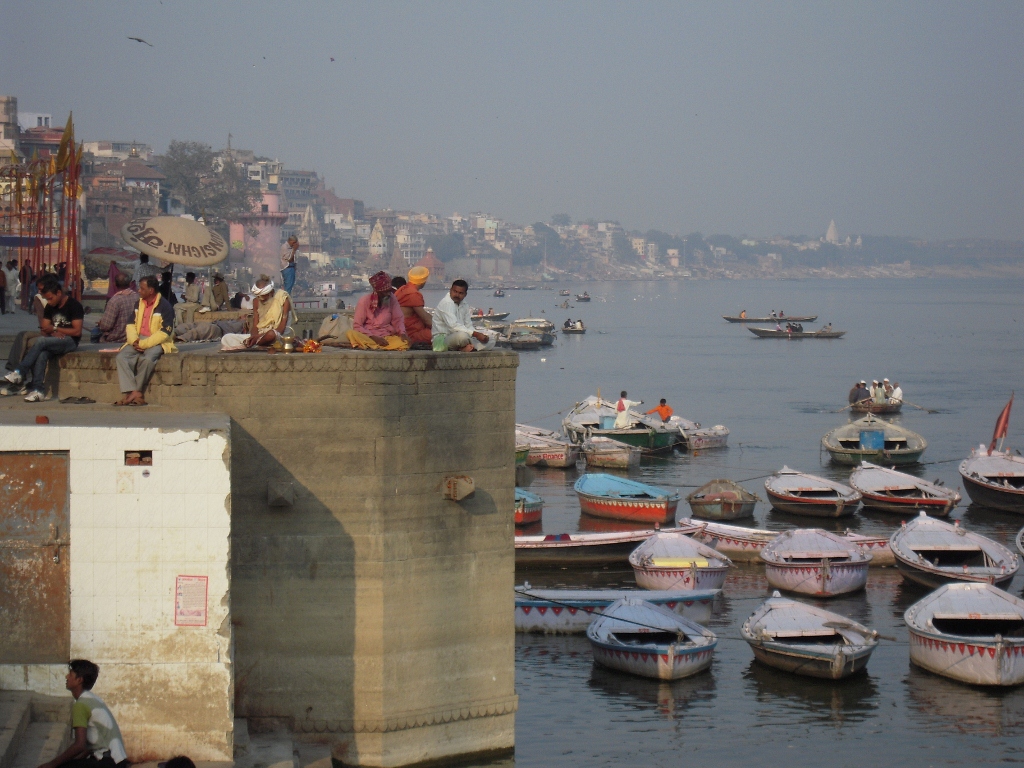
Varanasi Ghats

Traversing the ghats at Varanasi yesterday, either on foot or by boat, leaves me in a subdued and introspective mood.  On the one hand it is wonderful to join the escape from the cacaphony of road traffic, and ponder the timeless and holy symbolism of this place.  Still, one can’t escape the crowds and competing agendas – the handpainted advertisements on the sides of the holy men’s plinths, or the cricket-playing youths and importuning boatmen.  At dawn and dusk the steps are jammed with people absorbed in the widest range of social or intimate activities, bathing, promenading, reclining, gawking, doing business.  In a country of a billion people, there is no place without either history, sacred significance, or passers-by.  The habit of averting ones eyes, and expecting others to do likewise, is not just a personal affectation of the shy, but a necessary coping mechanism and a social convention.  Foreign tourists, rare quarrelling, and other strangenesses disturb the balance, especially for opportunistic bystanders, but the mark of fitting-in is to pass unnoticed, merging with traffic.  In spite of obvious differences, a sense of the common and normal – the reassurance that shared expectations make difficulties communicating momentary and trivial.  Travel as a process of discovering not differences but similarities – the same aspirations worked-out under circumstances more adverse or advantageous – hotter or colder, richer or poorer, more harmonious or competitive.

four seasons blanket

•21/12/2011 • Leave a Comment

These photos show the recently completed twill-tapestry project, an example of a mainly loom-woven twill fabric, with limited use of tapestry ornamentation.

four seasons blanket

Twill Tapestry on loom

•17/11/2011 • 2 Comments

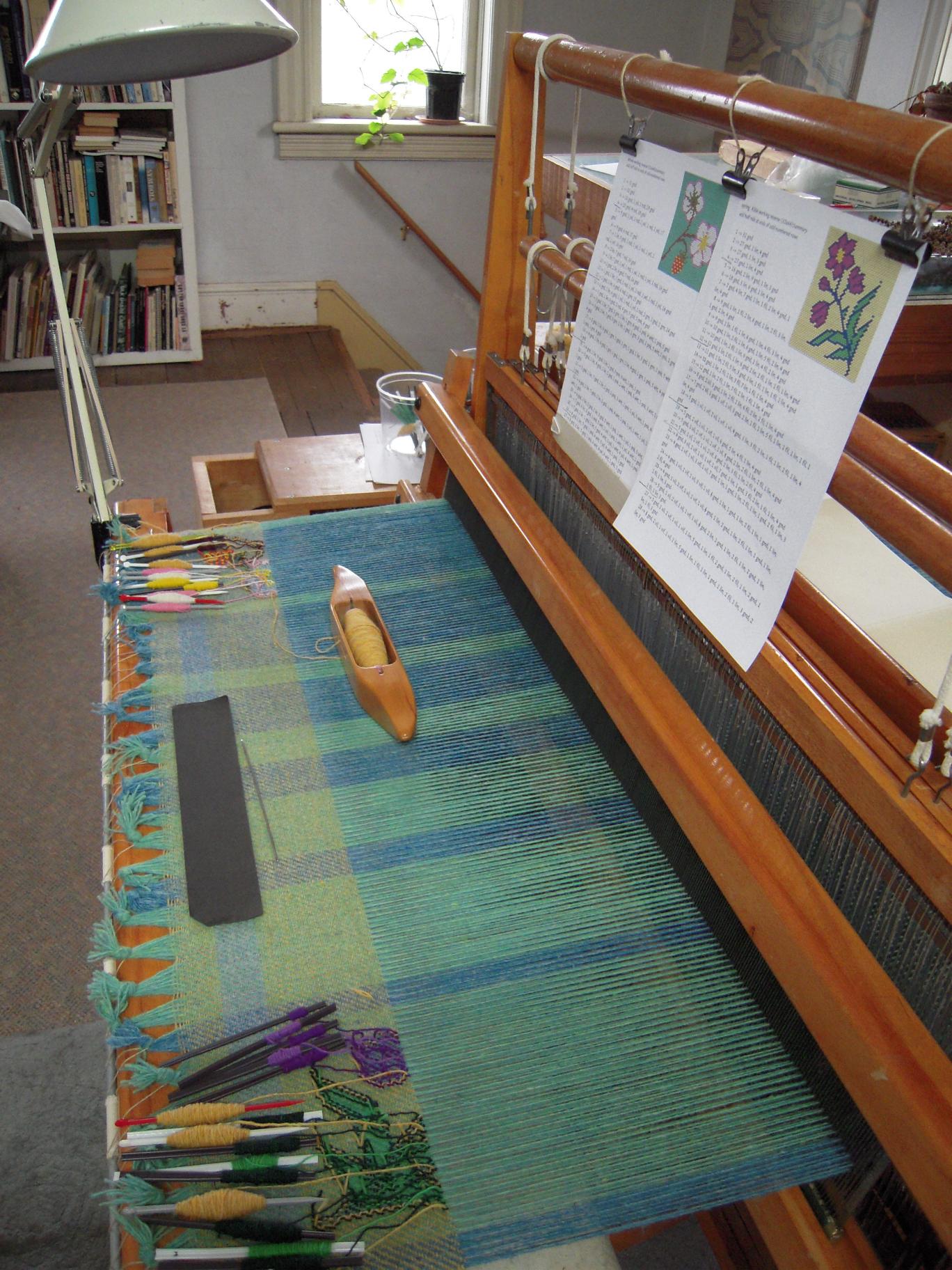
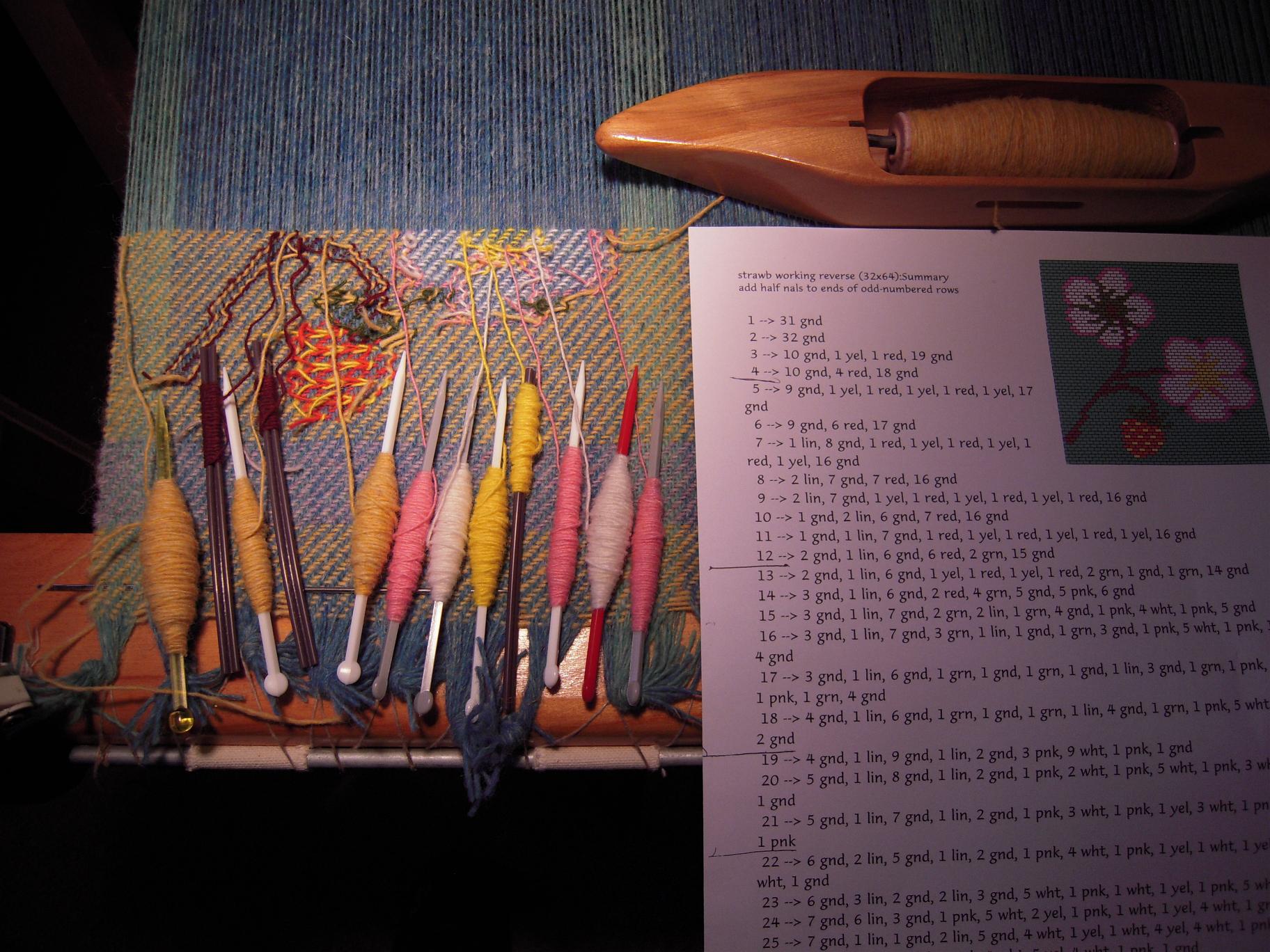
Right now I’m well-started on a twill-tapestry shawl project with tapestry motifs ornamenting the corners of a 2/2 straight twill fabric and showing a four-seasons theme.  The motifs were designed on a computer screen brick grid, and row-by-row weaving instructions (“talim” in the Kashmir shawl weaving tradition) generated, using Stitch Painter software.  Selections from my palette of single-ply wool yarns for warp and weft, weave comfortably at 20 ends per inch.  I’m using a collection of small, improvised bobbins for the tapestry wefts, and a shuttle for the intervening plain-colour areas.

overview of the loom

loom in profile

spring crocus with talim and design diagram

summer strawberry with talim and design diagram

crocus view from working side

strawberry view from working side

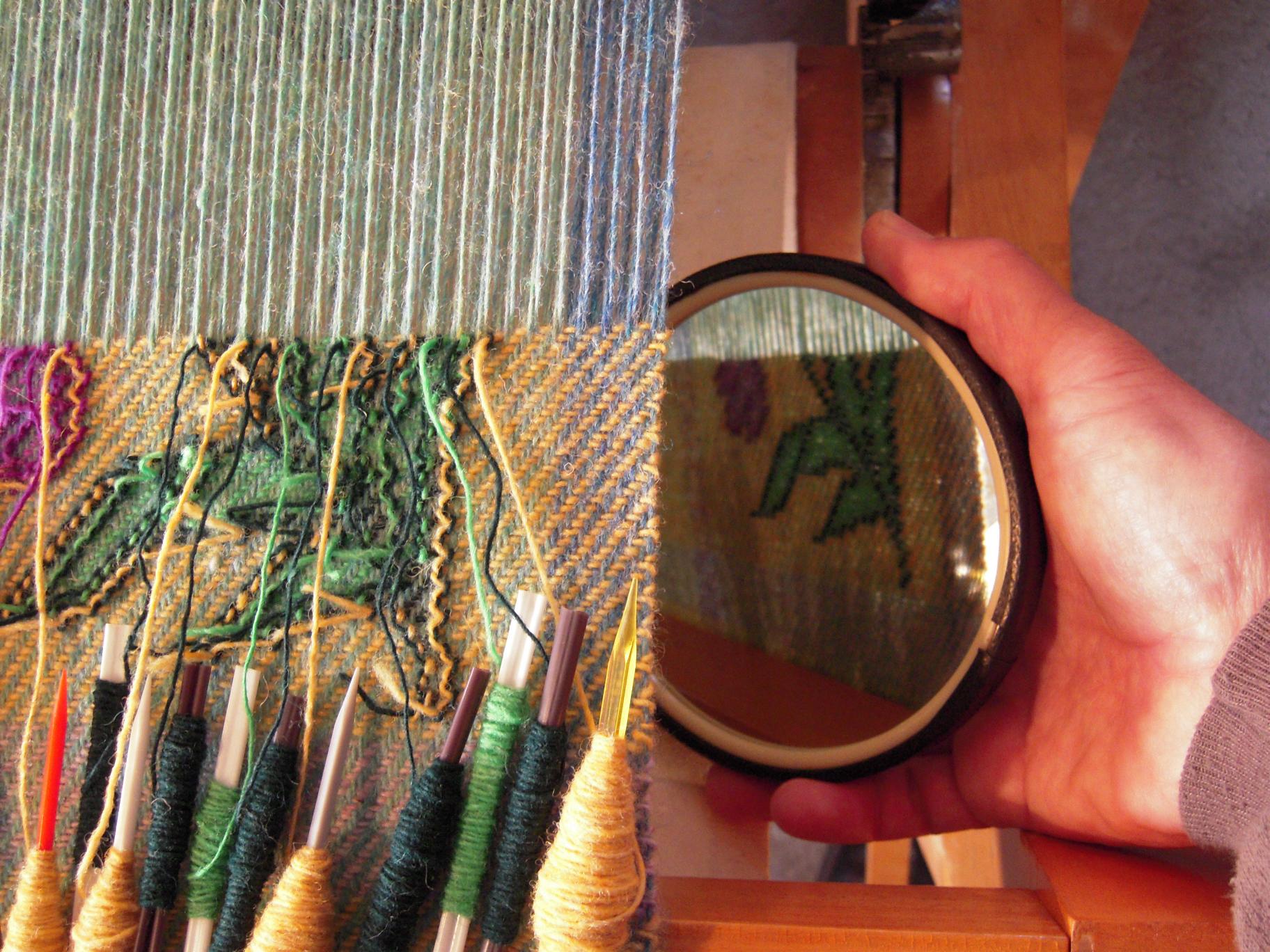
checking the front side

crocus front view

strawberry front view

crocus closeup

strawberry closeup

Book Review: “Woven Masterpieces of Sikh Heritage” by Frank Ames

•31/10/2011 • Leave a Comment

Woven Masterpieces of Sikh Heritage, Frank Ames; Antique Collectors’ Club, Woodbridge/UK 2010, ISBN 978-1-85149-598-6; 254 pages, colour illustrations, English text.

Frank Ames’ earlier book, “The Kashmir Shawl and its Indo-French Influence”, first published in 1986 and reprinted several times since, has become the standard-of-comparison text, from which other authors could branch off into other areas like Pakistani collections (Rehman & Jafri), or present-day production (Rizvi & Ahmed).  Now it has given him an opportunity to embrace diverse aspects of the subject in a more personal way, addressing possible influences like European herbals and expatriate military adventurers, and depictions in Indian and Persian court paintings.

One topic that Ames considers is the extent to which artists in royal ateliers producing miniature painting may have contributed to trends and regional preferences in shawl designs.  G. W. Leitner, a 19th-century documentarist, described the shawl design process by which the naqqash’s (the artist’s) line drawings were interpreted by the tarah guru (the weaving-workshop designer) adding and filling colours and judging how much detail could be retained in the weaving, from his viewing apparatus and his weaving experience.  I think that step in the process adds to the likelihood that any artists’ drawings from near or far, could be commissioned by their royal patrons and forwarded to Kashmir for shawl weaving.

When I was in Lahore in 1999, to give a workshop to National College of Arts textiles students, I idly visited the would-be museum of the work of M. Abdur Rahman Chughtai and met his son Arif.  There was an exhibition of graphic two-colour book dustjackets he had designed, in what seemed like the front parlour of the Chughtai home.  I was given books of his paintings, that remind me of Aubrey Beardsley’s Art Nouveau style, in the midst of which I found an elaborate arabesque drawing described as “a Naqashi Work”, suggesting he followed in the tradition of working to different styles and purposes.

I think the central thesis of Ames’ latest book, by contrast with John Irwin’s precursor “The Kashmir Shawl” (1974), and his earlier classic, is about the danger in history-writing of viewing events from a distance and assuming that they unfolded in a smooth, self-contained, and logical progression.  Especially where the early evidence, the textile fragments, are so scarce, and incidental comments on the shawl industry by royal biographers, are so vague.  From a distance, we automatically simplify, and gloss over the gaps in information and breaks implied by events of a different kind like religion or politics.  In the transitions from Mughal to Afghan to Sikh periods, and the intersections with Persian history and other movements along the Silk Road, there is so much scope for the advent of new influences, we might think if we were there that current events were bursting upon us just as we do today.  Whereas to the distant historian the dust has settled over all, conveying an impression of uniformity and logical connection.

In a discussion about surprising developments in the science of genetics, a quote attributed to Stephen Jay Gould described evolution as a process of “punctuated equilibrium”.  I object to the arbitrary re-definition of “evolution”, but I think it is fair to say that, as in the welter of scientific discoveries, so in the history of the shawl industry, “punctuated equilibrium” may be the right description of events and assumptions.

In the end, I think Ames is very brave and generous, from his position of expertise, to acknowledge and appeal for more evidence and more wide-ranging consideration of how the changing styles of shawls came down to us.  As a reader, with little to contribute, I was captivated and hugely entertained, and left not with pat conclusions, but a richer appreciation of the world of those times.  And as a viewer who has complained of the “soupy overall harmony” of 19th-century shawls, I was continually surprised by his selection of vivid and sharply-drawn examples.

Twill-tapestry Workshop

•31/10/2011 • Leave a Comment

From 8 – 12 August 2011 a workshop took place at my home and studio in rural Ontario on the subject of twill-tapestry weaving, the technique used to produce the historic Kashmir shawl.  It was a residential workshop with three students attending, two lodged in the house and one camping in the orchard with her own tent; home-cooked meals were provided, with all the amenities taking advantage of warm summer weather and locally-available fruit and vegetables.  Plans for evening programming faded as we lingered over late suppers, conversation, and glasses of red wine.
Two students had background in tapestry weaving and one in loom weaving, and all lacked familiarity with the other specialty.  Each student brought her own quite different table-top loom, capable of the four-shaft treadling needed for twill weave – every one required some individual troubleshooting to prepare to weave a balanced twill fabric.  Tapestry designs could be prepared on a “brick” grid to coordinate with the twill structure, either on graph-paper or on computer screen, and student approaches ranged from one with her own laptop, one using a studio computer, and one designing on paper but sampling the convenience of the computer screen by comparison.  After introductory sessions outlining the history of the shawl industry, design and technological development, and demonstrating the on-loom routines, students set to work designing their individual projects.
Interestingly, none of the students took time to practise the shawlweaving processes, but launched as soon as they could into the start of their project designs.  By the second and third days of sessions, the studio atmosphere of quiet concentration and progress was gratifying.  At week’s end one had cut off a sample of a major part of her miniature tapestry design, and the other two were well into the first of two or more design panels of their scarf projects.
A friend recently commented how little tapestryweavers know about any weave structure more complicated than the basic plain weave we always use.  Straight twill, requiring four shafts, is perhaps the first step up from plain weave, but it is a big one, and I’m surprised my students made it so easily.  Besides the complications of working from the back of the cloth, and double-weft-interlock, traditional Kashmir shawl technique requires weavers to follow numerical instructions derived from the design, instead of judging their progress visually, and to not let the design get thrown off by the advancing diagonal grain of the twill treadling.  I thought the ease with which we incorporated these adjustments was reassuring, and I hope this historical technique can make available a new option for embellishing loom-weaving with tapestry designs, for weavers outside the tradition.

Red Fleet Fleeing by Pam Patrie